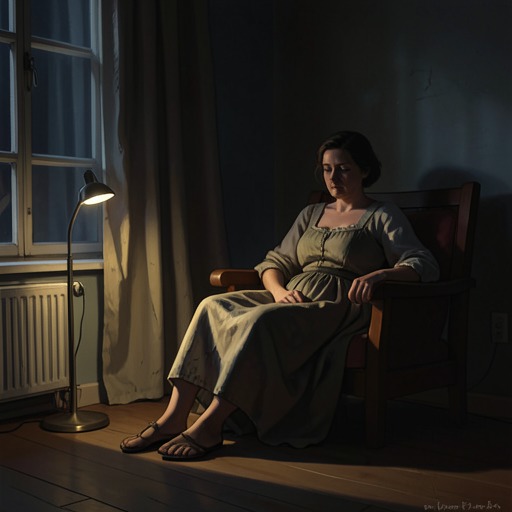
Etsuko's grief and guilt over Keiko's death
A Pale View of HillsEtsuko's grief and guilt over Keiko's death shape both what she remembers and what she tries to put aside. Keiko's suicide in Manchester, after years of isolation from her family, leaves Etsuko with a persistent image of a loss she could neither prevent nor fully explain. Even as she insists that her decisions were made with Keiko's interests in mind, her account returns to the possibility that her opposition and their estrangement helped leave her daughter beyond her reach.
A loss that remains present
Etsuko does not describe Keiko's death as a subject the family often discussed. She says that they never dwelt on it for long, but that it was never far away: it hovered at the edges of their conversations. The contrast gives the grief its particular force. Silence does not mean the loss has receded; instead, the unspoken death continues to shape the family's exchanges, including the visit that prompts Etsuko to remember the past.
That visit comes in April, when Niki returns to see her mother. Niki's concern is affectionate, but Etsuko understands that her daughter has also come with a purpose: to reassure her that the choices she made were not responsible for Keiko's death. Etsuko recognizes the care behind this effort, yet does not simply accept the comfort it offers. She says that she mentions Keiko partly to explain the circumstances of Niki's visit and partly because, during that visit, she began remembering Sachiko again. The movement from present grief to older memories makes recollection less a settled account than a route by which one painful subject leads to another.
The death and its aftermath
The public account of Keiko's death gives Etsuko little comfort. Newspapers emphasized that Keiko was Japanese and reported that she had died by suicide, presenting her nationality as though it were an adequate explanation. Etsuko objects to the English tendency to treat Japanese identity as evidence of an assumed national disposition toward suicide. In her recollection, this reporting reduces a particular woman's death to a racial generalization, obscuring the life and family circumstances behind it.
Etsuko's own thoughts turn instead to the time before Keiko was found. Keiko had lived in a room in Manchester, and the coroner later said that she had been dead for several days. The landlady opened the door because she thought Keiko had left without paying the rent. Etsuko recalls that this was her first thought on hearing the news, even before the shock registered: she wondered how long her daughter had been there undiscovered. The detail matters because it turns the fact of death into a further source of anguish—the fear that Keiko's isolation continued at the moment when she most needed someone to notice her absence.
Etsuko says that she has repeatedly brought this image to mind and that its horror has not diminished. Yet she also describes becoming familiar with the thought, as one might become intimate with a wound. This is not a resolution of grief. It is a record of how an unbearable image can become part of a person's inner life through repetition, remaining distressing even after it is no longer wholly unfamiliar.
Keiko's withdrawal and Etsuko's responsibility
Etsuko's remembered family life makes the later solitude in Manchester part of a longer pattern. For two or three years before Keiko left the family, she withdrew into her bedroom and rarely came out. She had no friends, and the family was not permitted to enter. Etsuko left Keiko's meals in the kitchen for her to collect, and their limited accommodation included an arrangement over laundry: every few weeks, Keiko would leave a bag outside her door for her mother to wash and return.
The household gradually adapted to this separation, but it did not remove the tension. When Keiko came into the living room, the family felt strained; her visits often ended in arguments with Niki or Etsuko's husband, after which she returned to her room. Etsuko's account therefore presents isolation not as a sudden condition that began in Manchester, but as a pattern already established within the home. That continuity sharpens her later fear that Keiko could remain unseen for days in a city where she knew no one.
Etsuko also looks back on her opposition to Keiko leaving home. She now recognizes that, in the country where they lived, it was not unusual for a young woman of Keiko's age to want to leave. She had believed that her unhappy daughter would find the outside world too difficult, and says that she opposed her for her own protection. But the outcome, as Etsuko frames it, was that Keiko eventually left while severing her ties with her mother. The care that Etsuko intended and the separation that followed remain joined in her memory, without becoming the same thing.
Reassurance, self-defense, and unresolved guilt
Niki tries to relieve her mother's sense of responsibility, but Etsuko believes Niki does not know what occurred during Keiko's final days in Japan. She suspects that Niki has formed her understanding from what her father told her and that this picture must contain inaccuracies. The disagreement is not simply over whether Etsuko is guilty. It is also over who can claim to know the past: Niki offers reassurance from a partial account, while Etsuko invokes memories that she says cannot be supplied by her father's version.
Etsuko does not present herself as having regarded her husband as a failure in his family role. She acknowledges that he worked hard, fulfilled what he understood as a husband's duties, and was a good father during the seven years he knew Keiko. She also recognizes that Keiko would have missed him. These acknowledgments complicate any simple division of family responsibility, even as Etsuko resists Niki's assumptions about what happened.
Her defense of herself is direct: she maintains that her motives for leaving Japan were justifiable and that she kept Keiko's interests in mind. Yet she also says she has no wish to go over the matter again. That refusal sits beside the repeated return of the death and the memory of Keiko's final isolation. Etsuko's grief and guilt thus remain unresolved—not because she openly declares herself responsible, but because her account keeps placing her protective intentions beside their painful consequences. The gap between what she meant to do and what she now fears she caused is the state's defining tension.